Roy Harper's Bullinamingvase and One of Those Days in England
A short edit of the England suite nearly put Roy Harper on Top of the Pops, and its B-side was the song his record company later pulled.
Track by track (7 tracks)
“Watford Gap” closes side one of Roy Harper’s Bullinamingvase with about three minutes on an M1 service station, and its chorus sums up the food as “a plate of grease and a load of crap.” Blue Boar ran the place and demanded the song’s removal. A man on Blue Boar’s board reportedly sat on EMI’s as well, and later pressings dropped the track for “Breakfast With You.” Side two holds the other England, the last 19 minutes of “One of Those Days in England,” a suite that opens the album on Excalibur and finds room for a ninth-century jewel and willow leaves hanging on into January.
Harvest released the album in Britain in 1977, and Chrysalis put it out in the US under the suite’s name. Harper still counts it among his real favorites. Punk was supposed to make his generation look tame that year, and the Harper song that got pulled for rudeness shared a record with a suite that reaches back to Alfred.
A long song in punk’s year
Peter Jenner, Harper’s manager, encouraged him to cut a single edit of the England song, and for a while in 1977 it looked like working. Capital Radio played it. Harper remembers a Top of the Pops slot being nearly his until the single missed the chart place it needed. Its B-side was “Watford Gap.”
He had reason to hope. Two years earlier he had sung lead on Pink Floyd’s “Have a Cigar.” His own HQ closed with “When an Old Cricketer Leaves the Crease,” the song John Peel insisted should be played in the event of his death. Then punk arrived. Fish of Marillion, who counts Bullinamingvase among his favorite albums, remembered the album going completely against the tide. Harper was largely ignored after that, and he said once you’re booted out there’s very little you can do about it. Uncut argued that a big part of Harper was “punker than punk,” and named “Watford Gap” as one example. The album reached No. 25 in Britain and was gone after two weeks.
Abbey Road, Leckie, Lawson and the McCartneys
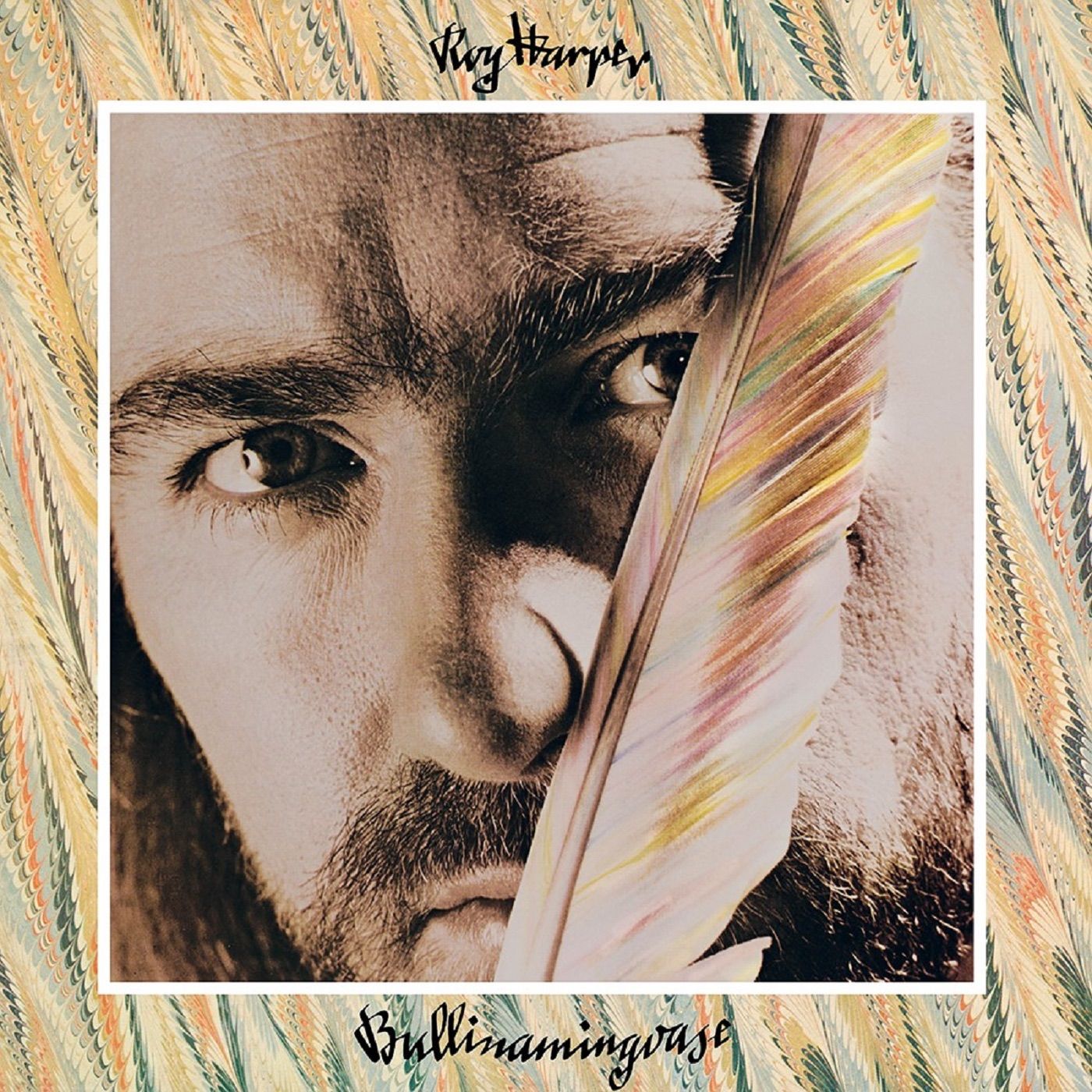
Harper made the record at Abbey Road and produced it with John Leckie. Dave Lawson of Greenslade played keyboards and wrote the arrangements, and Paul and Linda McCartney came in to sing backing vocals on “One of Those Days in England.” Home by then was Vauld Farm in Herefordshire, which Harper had bought in 1976, and he traces the pastoral feel of the album to his life there. Hipgnosis made the sleeve. It’s a sepia close-up of his bearded face, half hidden behind a pastel-streaked feather and framed in white on marbled paper of yellow, green and orange.
What One of Those Days in England is about
Harper goes to the Ashmolean as often as he can to see the Alfred Jewel, “for emotional sustenance.” Its inscription says Alfred ordered it to be made. He packed the jewel into the suite beside Excalibur in the first line and the willow leaves hanging on into January, and his notes call the whole song a collection of reminiscences. They also make a big claim for Alfred, as founder of the British Navy and, more importantly to Harper, of the English language. Had Alfred lost to the Danes, he suggests, a fifth of the world’s population might now speak some kind of Danish dialect. Harper calls the song “a touchstone of my long affair with my own culture,” and he let the present into it. One line plants a bomb in a street to change law and order. Another talks of brooding for better breathing spaces, and in 2017 Harper wrote that both lines still seem set to demand attention in global culture. Most times he picks up a pen, he tries to refer to the whole of himself, and on this record the whole of him took in a ninth-century jewel and a plate of grease on the M1.
The seven songs, in CD order
One of Those Days in England, Part 1
The album opens on the first part of the England song, 3:25 long, and its first line reaches for Excalibur. On the original LP the other nine parts wait for side two. Four songs and the turn of the record stand between the suite’s first part and the rest of it.
These Last Days
Harper hears this song as the subtle ushering in of a gentler album, and he thinks it may be the reason he files Bullinamingvase that way. He describes what it says as “not so much resignation to a certain maturity as recognition that negotiation in life is paramount to community.” It runs 4:26, second on both the LP and the CD.
Cherishing the Lonesome
Harper names three moods for the album: the pastoral feel of his life at the time, a lovelorn edge in “Cherishing the Lonesome” and angst in “Naked Flame.” The lovelorn song runs 5:54, longer than anything else on side one, and Rob Hughes calls it gorgeous.
Naked Flame
Harper’s word for this one is angst. It runs 5:06 and sat fourth on the first pressing, right before “Watford Gap,” so side one went from the lovelorn song to the anxious one to the motorway insult before the record turned over.
Watford Gap
The services sit between junctions 16 and 17 of the M1 in Northamptonshire, and the song about them was the shortest track on the 1977 LP. Sid Smith called it a throwaway. It was also the song a motorway company wanted off the record, and one of the songs Uncut picked as proof of the punk in Harper.
One of Those Days in England, Parts 2 to 10
Parts 2 to 10 take the whole of side two, 19:27 of the long song Dave Lawson arranged and played keyboards on. Fish heard Harper’s lyric running the show: “Roy is the words. The music becomes the backdrop to the words.” He heard warmth in the voice too, enough to set it beside Lowell George and John Martyn, along with the comic turns of phrase and a romantic feel in the way Harper performs.
Breakfast With You
“Breakfast With You” replaced “Watford Gap” on later pressings, and at 2:42 it is the shortest song on either version. The 1996 CD keeps both songs and puts this one last, after the suite. Nobody who bought the first LP had it at all.
After Bullinamingvase
By the early 1980s EMI had cast Harper aside, and he calls that stretch, when he was completely out of fashion, the low point of his life in music. Kate Bush’s cover of “Another Day” led to the two of them working together in 1980, with Harper singing on her “Breathing” and Bush guesting on his album The Unknown Soldier.
Harper set up his own label, Science Friction, in 1994 to put his back catalog out again. Its 1996 CD brought “Watford Gap” back. In 2017 he remastered the record with John Fitzgerald at Lettercolm Studio in Timoleague, West Cork, in Ireland, where he now lives. Track five on that remaster, as on the 1996 CD, is “Watford Gap.”