How Siouxsie and the Banshees Built Juju in Front of Live Crowds
Siouxsie and the Banshees played most of Juju's songs live and trimmed them before recording, and took the album's fears from the Yorkshire Ripper and tower-block cameras.
Track by track (9 tracks)
- 01Spellbound
- 02Into the Light
- 03Arabian Knights
- 04Halloween
- 05Monitor
- 06Night Shift
- 07Sin in My Heart
- 08Head Cut
- 09Voodoo Dolly
When Siouxsie and the Banshees walked into Surrey Sound in Leatherhead in 1981, the audience had already edited the album. The band had rehearsed the new songs and debuted most of them at shows in February and March, before recording was even on the table. “We’d already been through the ‘lose that verse, lose that change, you’re losing the audience’ bit already,” said Steven Severin, the bassist. All four knew what to play and which overdubs they wanted, and the album took one month out of a year of almost nonstop live work.
Juju ran 17 weeks on the UK chart and later wore the title of the ultimate goth album, which Siouxsie threw back in a 1998 Time Out interview. “‘Night Shift’ was about the Yorkshire Ripper, not Bela Lugosi, or whatever. Goth was pantomime.” Juju’s fears came out of the news, from a murderer in the north of England to security cameras in tower blocks, and even the skulls and beads at their shows arrived with one song.
Two new members and a set built on stage
Budgie and John McGeoch were still the new men. They had replaced John McKay and Kenny Morris, who walked out in the middle of a tour in September 1979, and Budgie had drummed on the Slits’ 1979 album Cut while McGeoch had come over from Magazine, where he played guitar. After Kaleidoscope in 1980 both were full-time Banshees, on equal shares with Siouxsie and Severin, and Siouxsie came to see Juju as the opposite of how that lineup had made Kaleidoscope.
Surrey Sound and a psychedelic brief
Nigel Gray had produced Kaleidoscope at McGeoch’s suggestion, because McGeoch liked the clarity of the Police’s “Walking on the Moon.” Gray was a qualified medical doctor who had converted Surrey Sound, the Leatherhead studio, on a tight budget, and the Police made Outlandos d’Amour and Reggatta de Blanc there with him before he co-produced Zenyatta Mondatta and won two Grammys with them. In Smash Hits, Severin set Gray against Join Hands. That record had been a fight for the sound on every track, and Gray was easy to work with. Severin and McGeoch talked about 1967 all through the sessions, the Rolling Stones of Their Satanic Majesties Request and the moment the Stones or the Small Faces went psych.
Gray’s early take on “Fireworks” turned up as a bonus track on the 2006 reissue. The 1982 remake carried the strings they wanted and reached No. 22 in Britain, and for Siouxsie it pointed the direction for the next album, A Kiss in the Dreamhouse. For Julian Marszalek of The Quietus, that record was a deliberate shift from the overt darkness of Juju. It was also the last one McGeoch made with the band. He had a breakdown in Spain, Robert Smith of the Cure took over on guitar, and the Banshees went on remaking their sound album by album up to Superstition.
McGeoch’s tools
Gray borrowed a Gizmo for McGeoch from his friend Lol Creme, and McGeoch later gave One Two Testing the details of how it worked. “There’s a row of six rotating serrated wheels, and six buttons which introduce the wheels to the strings, making a bowing sound.” It’s on “Into the Light.” Betty Page heard that track’s simple melodies and wordy rhymes repeat themselves into a trance.
The rest of the rig was plain. A Yamaha SG1000, an Ovation 12-string usually plugged straight into the desk, and an MXR flanger mounted on a mic stand, so he could hit a chord and sweep the knob by hand. To Page he was the only man who could make an acoustic guitar sound foreboding, and Johnny Marr, on BBC Radio 2’s The John McGeoch Story, later singled out the 12-string acoustic sound on “Spellbound” as something you didn’t hear much on records.
Fear without the fangs
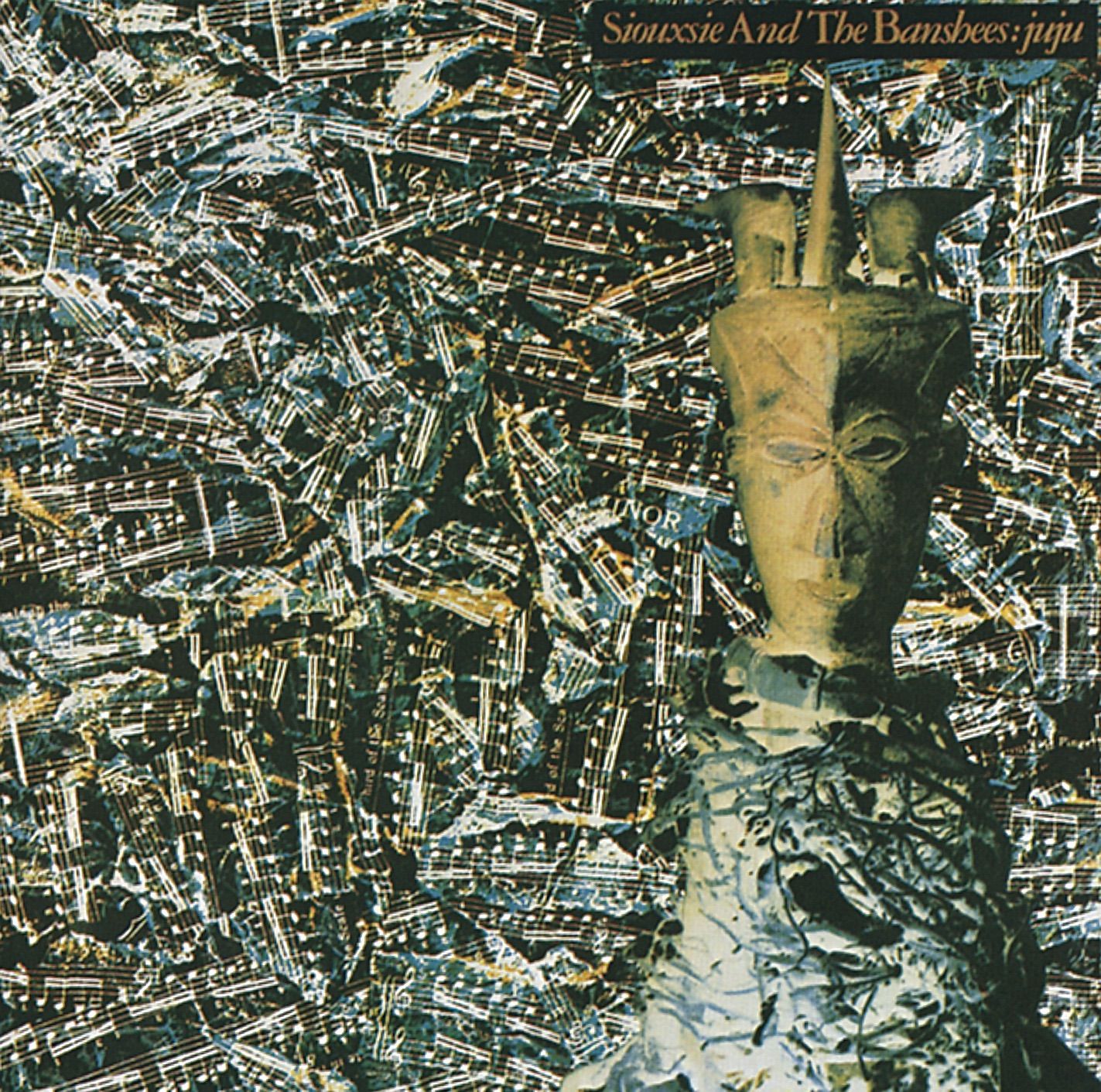
Nobody planned a theme. As the songs piled up, Severin noticed a darker thread running through them, and Juju became the first Banshees record he would call a concept album, for want of a better word. Much of the imagery started with a carved African statue the band found at the Horniman Museum in Forest Hill, which ended up on the front of the sleeve. Words like voodoo and spellbound were never meant to be taken literally, Siouxsie said the year after release. Only two of the lyrics were Severin’s, “Spellbound” and “Halloween,” and the second has no ghosts in it. It came from the moment, at about six, when he suddenly realized he was a separate person and had lost something like an innocence. McGeoch put the band’s angle in film terms. “We were more thriller than horror movie, more Hitchcockian blood dripping on a daisy than putting fangs in something.”
The look had other roots too. In the inner-sleeve photos Siouxsie wore white lipstick, and Severin compared her to a Mary Quant mod. Years later Siouxsie said the goth bands that came in their wake tried to copy Juju’s identity and only diluted it. “There was no sense of tension in their music.”
The songs
Siouxsie wrote the other seven lyrics, and on side two’s “Sin in My Heart” she played guitar as well. In Mark Paytress’s notes for the 2006 reissue, the song was her cue on stage to pick up her teardrop-style guitar. Right behind it comes “Head Cut,” which crowds shrunken heads, a beautiful mask in plastercast, and something kept fresh on ice into one lyric. Singing it left Siouxsie exhausted by the end.
Spellbound
The opener has Severin’s words and a household gone wrong, with toys gone berserk and elders who forget to say their prayers thrown down the stairs. Under Siouxsie’s voice sits McGeoch’s 12-string acoustic sound. Polydor put it out on May 22, a month ahead of the album, and it went to No. 22 in Britain as the first single. Four decades later the fourth season of Stranger Things gave it a new crowd.
Arabian Knights
Siouxsie wrote the lines about women veiled behind screens about the way women are treated in some religions. “It’s nothing to do with a ‘feminist’ thing, it’s like a humane thing,” she told the NME. If a race were treated that way rather than a sex, she pointed out, there would be uproar. She wanted melodies like the Doors running through it. “Arabian Knights” reached No. 32 as a July single, and years later she still called getting the word orifices onto the radio quite a thrill.
Monitor
At five and a half minutes, “Monitor” closes side one, the first of the record’s three long songs. Siouxsie took it from a story about muggings in tower blocks, where monitor cameras had gone in and the residents ended up watching the screens more than they watched television. In her lyric the victim looks strangely at the screen, as if her pain were the viewers’ fault.
Night Shift
Siouxsie wrote side two’s opener about Peter Sutcliffe, the Yorkshire Ripper, from a news journalist’s account of what was known about him before his arrest, rumor and all. The story went that Sutcliffe had been a gravedigger and a necrophiliac. At six minutes it was, for Severin, the least prepared song on the record. Somebody heard Led Zeppelin’s “Kashmir” in it, and the band chose to push it even closer.
Voodoo Dolly
Juju ends on its longest song, about seven minutes of “Voodoo Dolly.” For Siouxsie, everyone has their own personal voodoo dolly capable of destroying them, a bad habit or something they like but shouldn’t, and Severin said this was the song that brought all the skulls and beads out. In concert Siouxsie danced through it and fell to the stage floor at the show’s climax.